Why Tap Water Shows Up as Brown Crispy Leaf Tips on Houseplants
Quick Answer: Brown crispy leaf tips on sensitive houseplants are often caused by fluoride, chlorine, and dissolved salts in tap water accumulating in the leaf margins over months. Because plants move water out through the tips and edges, whatever is dissolved in it concentrates there and burns the tissue. Prayer plants, spider plants, dracaena, and calathea are the most affected. Flushing the pot thoroughly, switching to filtered or rainwater, and avoiding softened water resolve it, and existing damage will not reverse.
The humidity is fine. The watering routine has not changed. And every new leaf still turns brown and papery at the very tip within a few weeks.
This blog has covered humidity needs and the various causes of yellow leaves and leaf drop. Tip burn specifically has a different cause and it is one of the few plant problems that is genuinely about the water rather than about the watering.
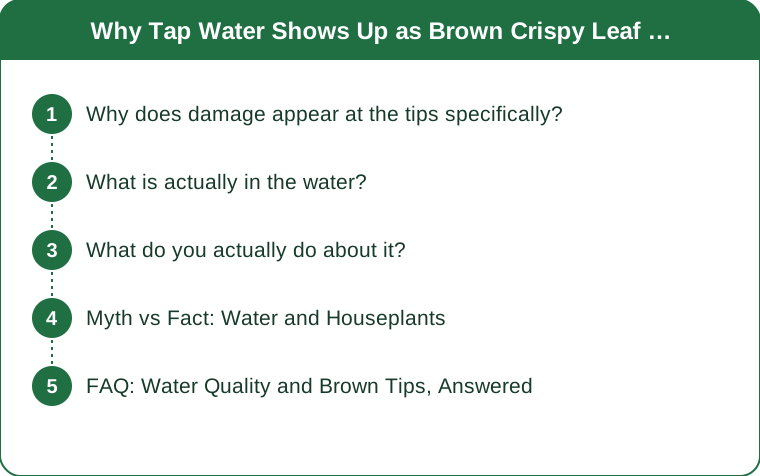
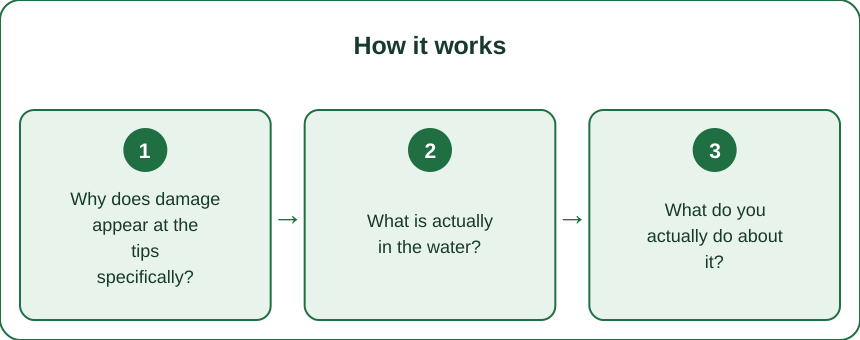
Why does damage appear at the tips specifically?
Because that is where the water ends up and everything dissolved in it stays.
Water moves through a plant in one direction. It enters through the roots, travels up through the vascular tissue, and exits as vapour from the leaves. The tips and margins are the end of that pipeline.
Minerals do not leave with the vapour. When water evaporates from the leaf, the dissolved solids stay behind. Over hundreds of watering cycles, those solids accumulate at the far end of the pathway, which is the tip and the outer margin.
Concentration eventually reaches a damaging level. When the local concentration of fluoride or salts exceeds what the tissue tolerates, the cells die, producing the characteristic dry, brown, papery tip with sometimes a yellow halo where the damage is spreading.
Which explains the pattern people find confusing. The damage appears on older leaves first, because they have been accumulating longest. New leaves emerge clean and then develop it over weeks or months. If your new growth looks perfect and then browns at the tip on a predictable schedule, accumulation is the mechanism.
And it explains why humidity fixes do not work. Low humidity does cause tip browning, and it produces a different pattern: broader, more diffuse browning, often across whole leaf edges, and it responds to humidity changes. Mineral burn is sharply localised at the very tip and does not respond to a humidifier at all. If you have been running a humidifier for a month with no change, this is likely your answer.
What is actually in the water?
Three things, with different effects and different fixes.
Fluoride. Added to drinking water in many regions for dental health, at levels harmless to people and genuinely damaging to a small group of sensitive plants. Fluoride is the classic cause of tip burn in dracaena, spider plants, and prayer plants. It is not removed by letting water sit out, which is the most persistent piece of misinformation on this topic.
Chlorine and chloramine. Used to disinfect water supplies. Chlorine does dissipate if water is left out for 24 hours. Chloramine, which many water utilities now use instead because it is more stable, does not dissipate and requires filtration. If your utility uses chloramine, leaving water out achieves nothing.
Dissolved salts and minerals. Every water supply carries dissolved solids, and hard water carries a lot. These accumulate both in the leaf tips and in the soil, where you can often see them as a white crust on the surface or around the drainage holes. Fertiliser adds to the same pool, which is why over-fertilising produces identical symptoms.
And the one to avoid entirely: softened water. Water softeners work by exchanging calcium and magnesium for sodium. The result has high sodium content, which is actively harmful to plants over time. Never water houseplants with softened water, and if your whole house is on a softener, look for an outside tap or a bypass, which is often present at the kitchen sink.
Which plants care? Prayer plants and calathea, spider plants, dracaena, cordyline, peace lilies, and many palms are sensitive. Pothos, philodendron, monstera, snake plants, and most succulents are largely indifferent. If your sensitive plant has brown tips and your pothos next to it looks perfect, that is a strong signal.
What do you actually do about it?
Flush first, then change the input.
1. Flush the pot thoroughly. Take the plant to a sink or bath and run water through the soil for several minutes, letting it drain freely. This dissolves and carries away accumulated salts. Do this every few months for sensitive plants, and always with water that is not the problem source if possible. This alone resolves a large share of cases.
2. Switch the water source. In rough order of practicality:
- Rainwater is the best option, free, and naturally low in dissolved solids. A bucket outside is genuinely sufficient. Autumn is the easiest season to collect it.
- Filtered water through a standard carbon filter removes chlorine and improves things. It does not reliably remove fluoride, which is worth knowing before you buy one for that purpose.
- Distilled or reverse osmosis water removes everything, including fluoride. Effective and less convenient and more expensive.
- Leaving tap water out overnight helps with chlorine only, does nothing for chloramine, fluoride, or salts. It is the most repeated advice and the least effective.
3. Reduce fertiliser. Fertiliser salts are part of the accumulated load. Sensitive plants generally need less than the label suggests, and diluting to half strength is a reasonable default. This blog has covered fertilising schedules separately, and reducing feed is the first thing to try alongside flushing.
4. Check for a white crust. Visible mineral deposit on the soil surface or the pot rim confirms the diagnosis and means a flush is overdue. Scraping off the top centimetre of soil and replacing it removes some of the load quickly.
5. Accept that damaged tissue will not recover. Brown tips stay brown. Trim them with clean scissors, following the natural leaf shape and leaving a thin margin of brown rather than cutting into healthy tissue, which just creates a new wound. You are judging success by whether new leaves stay clean, not by the old ones improving.
Myth vs Fact: Water and Houseplants
Myth: Leaving tap water out overnight makes it safe for plants. Fact: It allows chlorine to dissipate. It does nothing for chloramine, which many utilities now use instead, and nothing at all for fluoride or dissolved salts. For fluoride-sensitive plants, this advice does not help.
Myth: Brown tips always mean low humidity. Fact: Low humidity produces broader, more diffuse edge browning that responds to humidity changes. Mineral burn produces sharply defined browning at the very tip and does not respond to a humidifier at all. The pattern tells you which you have.
Myth: Filtered water solves everything. Fact: A standard carbon filter removes chlorine and improves taste, and does not reliably remove fluoride. If fluoride is your problem, you need rainwater, distilled, or reverse osmosis.
Myth: Softened water is fine because it is gentler. Fact: It is the worst option. Softeners replace calcium and magnesium with sodium, and sodium accumulation in soil is actively damaging. Use an unsoftened tap if you have one.
Myth: Trimming brown tips harms the plant. Fact: Trimming is cosmetic and harmless when done properly. Leave a thin brown margin rather than cutting into live tissue, which would simply create a new browning edge.
Myth: If one plant has it, they all will. Fact: Sensitivity varies enormously. Prayer plants and dracaena are highly sensitive; pothos and snake plants barely notice. A room where one plant browns and others do not is showing you a sensitivity difference, not a care difference.
Seasonal note: as heating comes on, low humidity browning and mineral burn can appear at the same time and look like one problem. This blog has covered why houseplants drop leaves when the heating starts, and it is worth separating the two before treating either.
FAQ: Water Quality and Brown Tips, Answered
Why do my houseplant leaves have brown crispy tips?
On sensitive species, usually fluoride and dissolved salts in tap water accumulating at the leaf tips over months. Water exits the leaf as vapour and leaves the minerals behind, so they concentrate at the end of the pathway.
Does letting tap water sit out overnight help?
Only for chlorine. It does nothing for chloramine, which many water supplies now use, and nothing for fluoride or dissolved salts. It is the most commonly repeated and least effective piece of advice on this topic.
Which plants are most sensitive to tap water?
Prayer plants and calathea, spider plants, dracaena, cordyline, peace lilies, and many palms. Pothos, philodendron, monstera, and snake plants are largely unaffected, which is why one plant can brown while its neighbour looks perfect.
Will brown tips turn green again?
No. Damaged tissue does not recover. Trim it following the leaf shape and leaving a thin brown margin, then judge success by whether new leaves stay clean.
TL;DR:
- Water leaves the plant as vapour and leaves its dissolved minerals behind at the tips, where they accumulate and burn the tissue.
- Fluoride is the classic cause in prayer plants, spider plants, and dracaena. Letting water sit out does nothing about it.
- Flush the pot thoroughly every few months, switch to rainwater if you can, and never use softened water.
- Sharp browning at the very tip is mineral burn; broad diffuse edge browning is humidity. They need different fixes.
Put a bucket outside this week. Rainwater is free, it is the best option available, and autumn is the easiest time to collect it.
Keep Reading
This article is for general informational and styling purposes only. Fit, sizing, and product availability may vary.