Why Does Turning the Heating On Change Your Houseplants Overnight?
Quick Answer: Central heating warms air without adding moisture, so relative humidity in a heated room drops sharply — often to levels well below what most common houseplants evolved with. Warm dry air pulls moisture from leaves faster, radiators create air movement that accelerates it further, and pots near heat sources dry out much more quickly than the rest. The change happens within a day, which is why plants react so abruptly.
The plants were fine on Sunday. The heating came on Monday.
By Friday there are crispy edges on three of them.
This is general information, not medical advice.
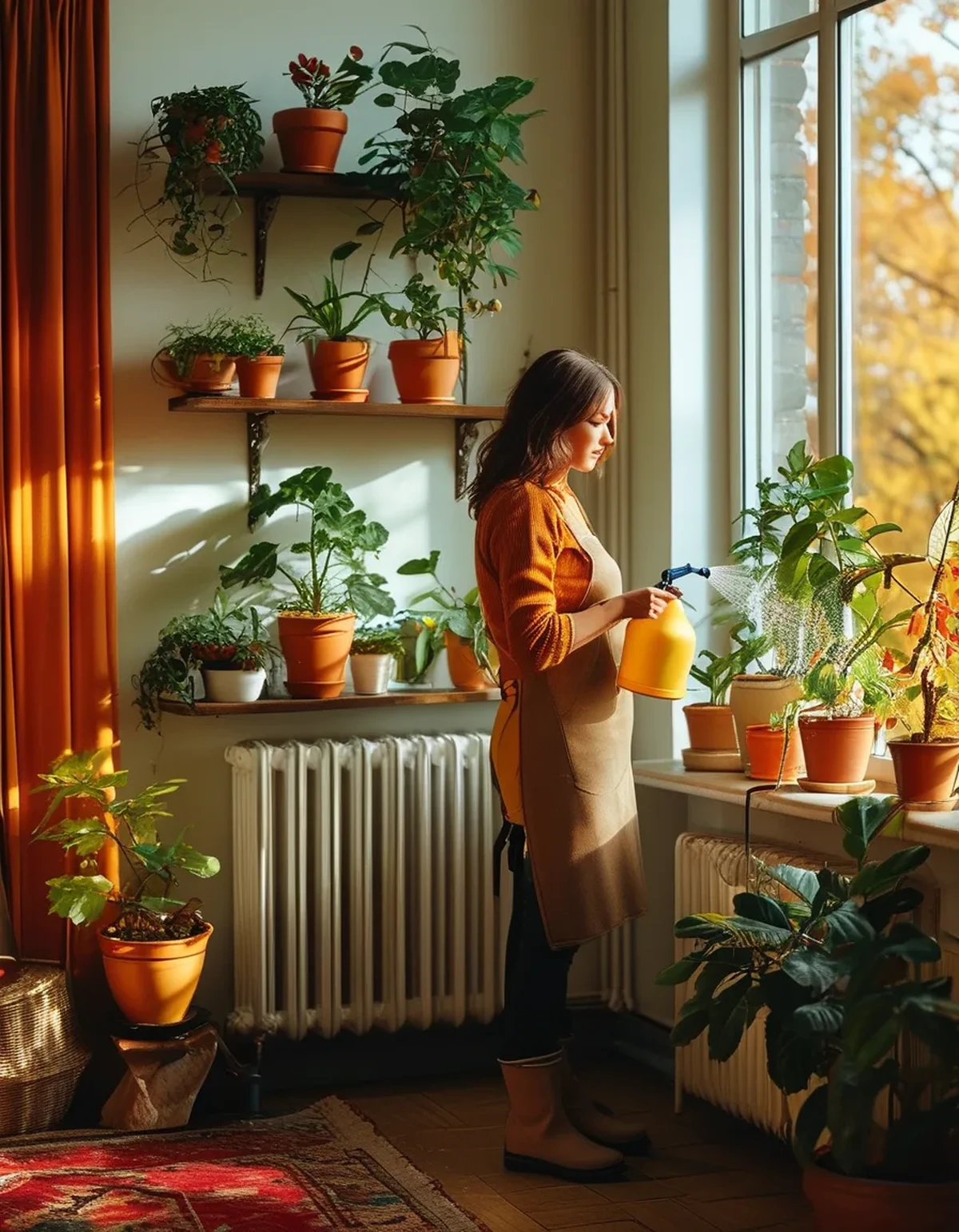
What actually happens to the air when the heating comes on?
The moisture content stays the same and the air’s capacity to hold moisture goes up. The result is a steep fall in relative humidity.
Warm air can hold considerably more water vapour than cold air. When cold outdoor air is drawn into a house and heated, it does not gain any water on the way — so its relative humidity plummets. A heated room in winter is frequently drier than most people assume, and often drier than many common houseplants are adapted to.
Most popular houseplants originate in tropical or subtropical environments where ambient humidity is high. They are tolerant of ordinary indoor conditions in summer, when indoor humidity is closer to outdoor levels. Heated winter air is a genuinely different environment.
The plant’s response is mechanical. Transpiration — water moving up from the roots and evaporating out through the leaves — accelerates in dry air, because the moisture gradient between the leaf and the surrounding air is steeper. The plant loses water faster than it did a week ago, from the same root system, in the same pot.
When the roots cannot keep up, the parts furthest from the water supply suffer first. That means leaf tips and edges, which is why the classic symptom is brown crispy margins rather than whole-leaf collapse.
Is this the same as underwatering?
The symptom overlaps and the cause differs. Underwatering is not enough water going in; low humidity is too much water going out. Both can be happening simultaneously in autumn, which is what makes diagnosis confusing.
Why do radiators make it worse than the temperature alone?
Because they add air movement and create localized extremes.
Convection currents. A radiator heats air, which rises, drawing cooler air across the floor to replace it. This creates continuous air movement, and moving air strips moisture from leaf surfaces considerably faster than still air does. A plant sitting in the convection stream above a radiator is in a small wind tunnel of dry warm air.
Localized heat on the pot. A pot on a windowsill directly above a radiator gets warmed from below. Warm soil loses moisture much faster, and roots sitting in repeatedly warmed and dried compost do not respond well.
Wild temperature swings. Heating on a timer means a room that is warm in the evening and considerably colder overnight. Plants near windows get the worst of both — heated air in the evening, cold draught and glass contact at night. Fluctuation is more stressful than either temperature alone.
Draughts from doors and vents. Any position in a through-draught combines air movement with temperature change.
The practical consequence is that position matters more in winter than at any other time of year. The spot that was ideal in July may be the worst in the house in November, and the plant has not moved.
Where should plants go instead?
Away from radiators, away from direct draughts, and not pressed against cold glass. A shelf in the middle of a room is often better than a windowsill once the heating is on, provided there is still enough light.
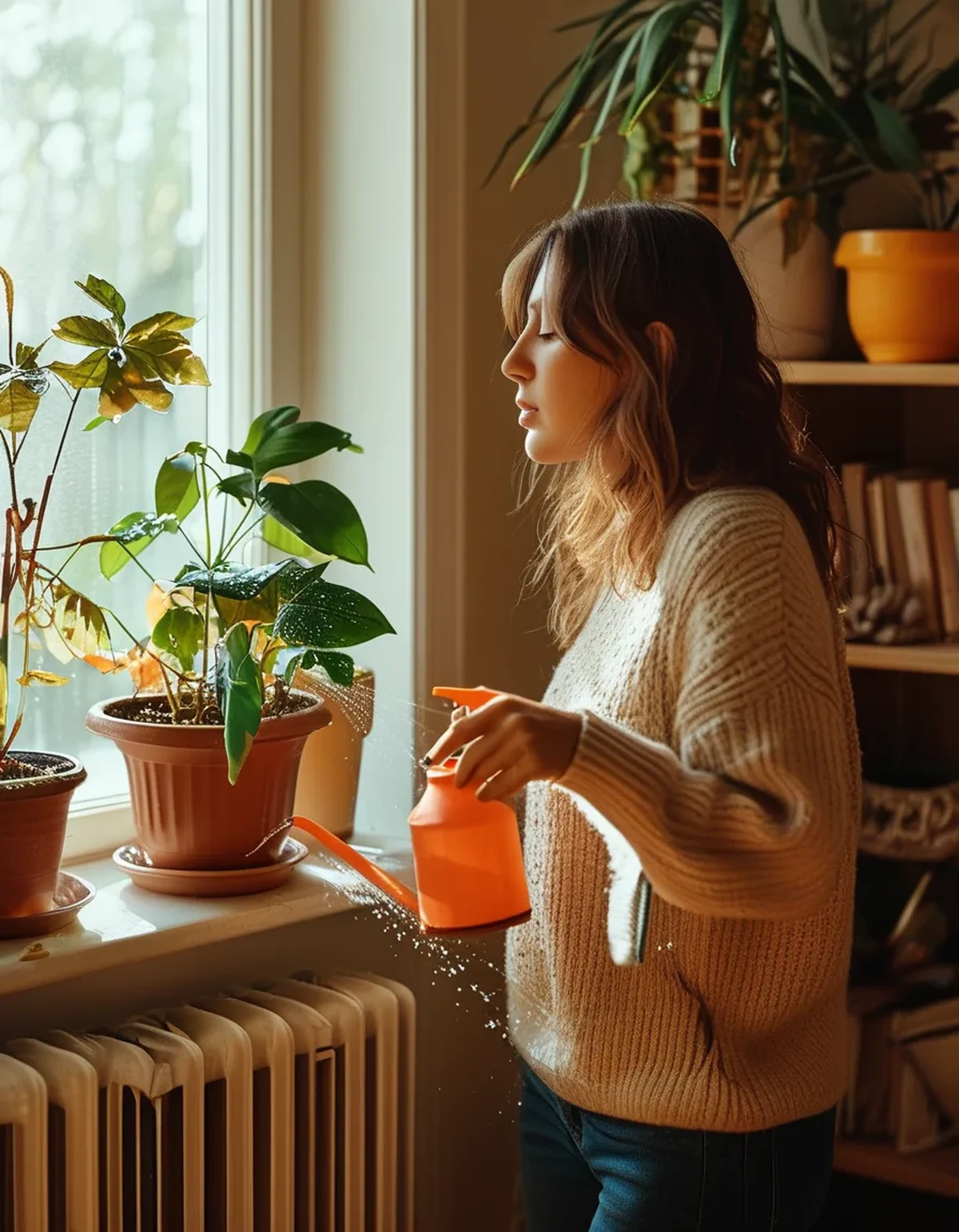
What to actually change
1. Move plants away from heat sources first. Free, immediate, and the highest-impact change. Anything directly above or beside a radiator should move. A distance of even a metre makes a substantial difference.
2. Group plants together. Plants transpire, and a cluster creates a slightly more humid microclimate around itself. This is one of the more genuinely effective humidity measures and it costs nothing.
3. Use pebble trays properly. A tray of water with pebbles, with the pot resting on the pebbles and not in the water. Evaporation raises humidity locally. The pot must not sit in standing water, which causes root problems.
4. Reconsider watering frequency in both directions. This is where people go wrong. Lower light in autumn means slower growth and less water use — pointing toward less frequent watering. Heating means faster drying — pointing toward more. The two effects partly cancel and the balance differs by position in the room.
Stop watering on a schedule entirely and check the compost instead. Push a finger a couple of centimetres in, or use a wooden skewer and see what comes out. Plants near radiators may need more water than in summer; plants in cool corners with low light may need much less.
5. A humidifier, if the problem is widespread. The most effective solution where several plants are struggling. It also tends to be pleasant for the people in the room.
6. Misting is largely cosmetic. It raises humidity for a few minutes and does very little for the hours in between. It is not harmful for most plants, and it is not a solution.
Which plants suffer most?
Those with thin leaves and high humidity requirements — calatheas, ferns, marantas, and alocasias are the usual casualties. Succulents, cacti, snake plants, and ZZ plants are largely unbothered by dry air.
5 mistakes people make when the heating comes on
1. Increasing watering to fix crispy leaves. The instinctive response and often the wrong one. Crispy tips in dry air are usually a humidity problem, and adding water to compost that is already damp leads to root rot — which then produces symptoms that look even more like underwatering. Check the compost before adding anything.
2. Leaving plants on windowsills above radiators. The single worst position in a heated house: dry convection currents from below, cold glass at night, and a warmed pot. It is also the position with the best light, which is why people persist with it.
3. Repotting to solve the problem. Autumn and winter are generally poor times to repot, since the plant is not in active growth and cannot recover quickly. Wait for spring unless there is an urgent root problem.
4. Feeding at summer rates. Reduced light means reduced growth means reduced nutrient demand. Continuing to feed at the summer schedule leads to salt build-up in the compost, which causes brown leaf tips — the same symptom you are trying to fix.
5. Assuming the leaf damage will reverse. Brown crispy tissue does not turn green again. Fixing conditions prevents new damage; it does not repair what has already happened. Trim the damaged edges if you like the look, and judge your progress by new growth rather than by old leaves.
FAQ: Heating and Houseplant Questions, Answered
How dry is too dry?
Many tropical houseplants do best above roughly 50 percent relative humidity, and heated rooms frequently sit well below that. A cheap hygrometer removes the guesswork and is worth the small cost if you have several sensitive plants.
Do pebble trays actually work?
They produce a modest local increase in humidity around the plant. Grouping plants and a humidifier both do more, and a pebble tray is a reasonable low-effort addition.
Should I move plants to the bathroom?
Bathrooms are usually the most humid rooms in the house, so it genuinely helps — provided there is adequate light. A humid dark bathroom trades one problem for another.
Why are only some of my plants affected?
Different origins, different tolerances, and different positions in the room. A plant a metre from the radiator is in a meaningfully different environment from one directly above it.
Is it better to keep the heating lower?
For the plants, yes, and for most households the heating is set for the people. Moving the plants is more practical than moving the thermostat.
When will things stabilize?
Once the heating pattern settles, most plants adjust within a few weeks. The abrupt change is the stressful part rather than the conditions themselves, and plants that survive the transition usually hold steady through winter.
TL;DR:
- Heating raises air temperature without adding moisture, so relative humidity collapses within a day.
- Faster transpiration in dry air damages leaf tips and edges first, which mimics underwatering.
- Radiators add convection currents, warm the pot from below, and create overnight temperature swings.
- Move plants away from heat sources and group them together — both are free and effective.
- Check the compost rather than watering on a schedule; lower light and faster drying partly cancel out.
The plants did not decline gradually. Something in the room changed on one specific day, and that is usually the day the heating came on.
This is general information, not medical advice.
Keep Reading
This article is for general informational and styling purposes only. Fit, sizing, and product availability may vary.