Why Repotting Your Houseplants in Autumn Is Usually a Mistake
Quick Answer: Repotting always causes some root disturbance, and a plant recovers from that by growing new roots — which requires active growth, which requires light. As light levels fall through autumn, most houseplants slow down substantially, so a plant repotted now sits in a larger volume of soil it cannot use, staying wet far longer than it should. That is the direct route to root rot. Wait until late winter or early spring unless there is an urgent reason not to.
The plant is not going to outgrow the pot before March.
And the risk of doing it now is considerably higher than the risk of waiting.

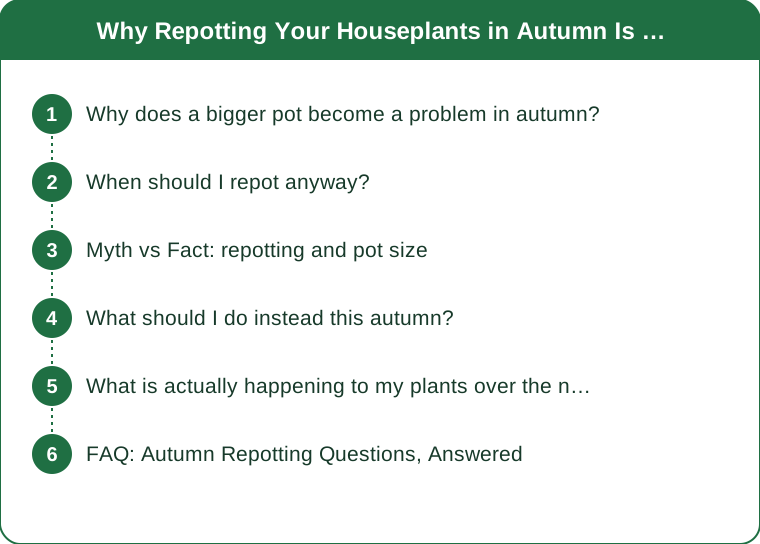
Why does a bigger pot become a problem in autumn?
Because soil dries by two mechanisms, and both slow down at once.
Water leaves the pot through evaporation from the surface, and through the plant using it — transpiration. Of the two, a healthy actively growing plant accounts for a large share.
In autumn:
Light falls sharply, and photosynthesis with it. A plant that is not photosynthesising much is not moving much water. Indoor light levels in autumn and winter can be a small fraction of summer levels, and the difference is far larger than it looks to the eye, which adapts.
Growth slows or stops. Most tropical houseplants are not truly dormant, but they slow dramatically in low light. A plant that is not growing does not need more root space, and it will not fill new soil.
Humidity indoors changes, and heating comes on, which affects evaporation in complicated ways — often drying the surface while the deeper soil stays wet.
So you have a pot with more soil, a plant using less water, and roots that will not grow into the new space until spring. The extra soil stays wet for weeks.
Wet soil that roots are not occupying is the classic root rot situation: anaerobic conditions around roots that are already stressed from being disturbed. That combination is what kills plants after repotting, not the repotting itself.
Is this true of every plant?
Mostly. Plants under strong grow lights, in a greenhouse, or in a very bright south-facing spot may continue growing and can be repotted later than the general rule suggests. The rule tracks light, not the calendar.
When should I repot anyway?
There are genuine exceptions, and it is worth knowing them so you do not wait while a plant declines.
Repot now if:
- The plant is in soggy soil that will not dry, and you suspect root rot. In this case waiting makes it worse. Remove it, inspect the roots, cut away anything soft and brown, and repot into fresh, well-draining soil — in the same size pot or smaller, not larger.
- There is a pest problem in the soil, such as a fungus gnat infestation you cannot control, or root mealybugs.
- The plant has just been bought and is in poor-quality nursery medium that stays sodden. Often worth doing straight away.
- The pot is broken, or the plant is genuinely unstable and falling over.
- The roots have completely filled the pot to the point that water runs straight through without wetting anything.
Wait until late winter or early spring if:
- The plant simply looks like it could use more space.
- A few roots are visible at the drainage holes, which is normal and not urgent.
- You bought a nicer pot.
- Growth has slowed — which in autumn is expected and not a sign of being pot-bound.
The timing to aim for: when day length is visibly increasing and you can see new growth beginning. In most northern climates that means late February through April, and the signal to watch for is new leaves rather than a date.
Myth vs Fact: repotting and pot size
Myth: Plants need repotting every year. Fact: Most need it every two to three years, and some — including many that flower better when snug — prefer to be left alone considerably longer.
Myth: A bigger pot makes a plant grow bigger, faster. Fact: It usually slows growth, because the plant diverts energy to roots and because the excess wet soil stresses the existing ones. Go up one pot size only, roughly 2 to 5 centimetres wider.
Myth: Roots at the drainage hole mean it is urgent. Fact: A few roots emerging is completely normal. Roots circling densely around the entire root ball with almost no soil visible is the actual signal.
Myth: You should loosen or tease out the roots every time. Fact: Gently loosening a tightly circling root ball helps. Aggressively pulling roots apart causes damage that a plant in low light cannot repair. Be gentler in autumn than you would be in spring — or better, wait.
Myth: Adding gravel at the bottom improves drainage. Fact: It does the opposite. A layer of coarse material creates a perched water table, raising the level at which water sits within the pot. Use a well-draining mix throughout and a pot with drainage holes instead.
Myth: Fresh soil in autumn gives the plant a nutrient boost for winter. Fact: A plant in low light is not taking up much nutrition. Fresh soil is more useful when growth resumes, and fertilising in deep winter is generally unnecessary.
Myth: Terracotta versus plastic does not matter much. Fact: It matters considerably in winter. Terracotta is porous and dries the soil faster, which is a genuine advantage in the low-light months for anyone who tends to overwater.
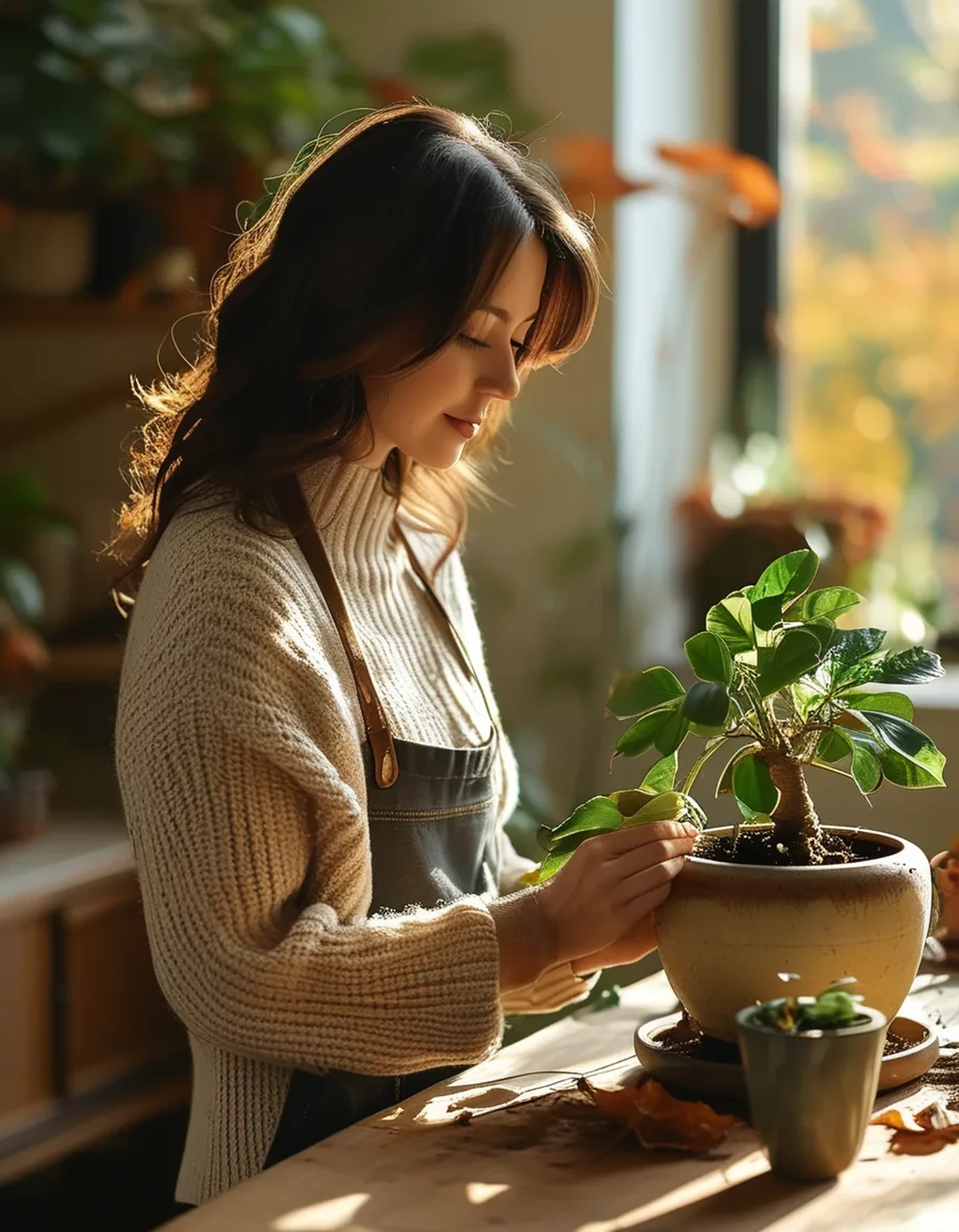
What should I do instead this autumn?
There is plenty that is genuinely useful now, and most of it is about reducing water.
- Water less, and by weight rather than by schedule. Lift the pot. A dry pot is noticeably lighter. This is the most reliable method available and it costs nothing.
- Check the drainage hole is not blocked and that the pot is not sitting in a saucer of standing water.
- Move plants closer to windows. A plant a metre from a window receives a fraction of the light one on the sill receives, and the difference is much greater than it appears. This is the single most valuable autumn action.
- Clean the leaves. Dust reduces light reaching the leaf surface, which matters far more when light is scarce.
- Clean the windows, genuinely. It is a measurable improvement in a dark month.
- Stop or reduce fertilising as growth slows.
- Rotate plants so they do not lean toward the diminishing light.
- Move plants away from radiators and cold draughts. Both are more damaging than a slightly small pot.
- Deal with pests now, since populations rise in the warm dry air of a heated home and a stressed low-light plant fights them poorly.
And if a plant genuinely needs help before spring: consider a grow light rather than a bigger pot. A modest light extends the growing season substantially and it solves the actual limiting factor, which is light rather than root space.
What if I already repotted in September?
Do not panic, and water very carefully. Let the soil dry more than you normally would between waterings, keep it in the brightest spot available, and do not fertilise. Most plants come through fine — the risk is elevated, not certain.
What is actually happening to my plants over the next few weeks?
Worth knowing, because a lot of autumn plant anxiety is a response to entirely normal changes.
Light drops fastest around the equinox. The rate of change is at its maximum right now, which is why plants often seem to change behaviour suddenly in late September rather than gradually.
Some leaf loss is normal. Plants shed lower or older leaves as they adjust to lower light. A ficus dropping leaves in October is usually responding to the light change, not dying, and it is the most common autumn panic.
Growth stops. New leaves become infrequent or cease entirely. This is expected and is not a sign of a problem.
Soil stays wet much longer. The same watering routine that worked in July will drown a plant in November. This is the number one killer of houseplants, and it is almost entirely a failure to adjust watering to the season.
Heating comes on, which dries the air considerably and creates a confusing situation — dry air and wet soil at the same time. Misting does very little; grouping plants together and using a pebble tray helps a bit; the real answer is choosing plants suited to your conditions.
Pests increase. Spider mites thrive in warm dry heated air, and scale and mealybugs become more visible on stressed plants. Check the undersides of leaves every few weeks through the winter.
The short version of autumn plant care: more light, much less water, no repotting, no feeding, and watch for pests. That is most of it.
When will they start growing again?
Most houseplants resume noticeably when day length increases enough — commonly from late February onward in northern climates. That is also the point at which repotting becomes the right move again.
FAQ: Autumn Repotting Questions, Answered
How do I know if a plant is truly pot-bound?
Slide it out. If it is a solid mass of circling roots with very little visible soil, and water runs straight through the pot, it needs repotting. A few roots at the bottom does not.
Can I repot in autumn if I use a grow light?
Yes, more safely. Under adequate artificial light a plant continues growing and can occupy new soil, which removes the main risk.
What size pot should I go up to?
One size — roughly 2 to 5 centimetres wider in diameter. Larger increases the wet-soil risk considerably.
Should I repot a plant I just bought in September?
Only if the medium is waterlogged or there is a pest problem. Otherwise let it acclimatise and repot in spring.
Is it safe to top-dress instead?
Yes, and it is a good autumn compromise. Replace the top few centimetres of soil without disturbing the roots.
Do succulents follow the same rule?
More strictly, if anything. They are highly vulnerable to wet soil in low light, and autumn repotting into a larger pot is a common way to lose them.
TL;DR:
- Repotting works by prompting new root growth, which needs light — and light is what autumn removes.
- A larger pot in low light means soil that stays wet for weeks, which is the direct route to root rot.
- Repot now only for root rot, soil pests, waterlogged nursery medium, a broken pot, or roots that have completely filled it.
- Go up one pot size only. Bigger is not better and usually slows growth.
- Gravel at the bottom worsens drainage — it raises the perched water table.
- Instead: move plants closer to windows, clean the leaves, water by weight, stop feeding, watch for pests.
- Wait for new growth in late winter or early spring, not a date on the calendar.
The pot is not the limiting factor between now and March. The light is.
Keep Reading
This article is for general informational and styling purposes only. Fit, sizing, and product availability may vary.