Why Dusty Leaves Cost Your Plant More Light Than Moving It to a Darker Corner Would
Quick Answer: Dust settles on leaf surfaces and both blocks and scatters incoming light before it reaches the chloroplasts, and it also partially obstructs stomata, the pores that handle gas exchange. On a plant that has not been cleaned for months, this can reduce usable light noticeably — often more than the difference between two positions in the same room. Wiping leaves every four to six weeks is one of the highest-return, lowest-effort things you can do for an indoor plant.
You moved it twice. You bought a light meter app. You considered a grow light.
The leaves have not been wiped since you bought it.
Start there.
Why does dust matter so much?
Because photosynthesis depends on light actually reaching the inside of the leaf, and dust intercepts it first.
Dust blocks and scatters incoming light. A particulate layer both absorbs some light and scatters the rest, and scattered light that never reaches the chloroplast does no photosynthetic work.
Indoor light is already marginal. A spot a couple of metres from a window receives a small fraction of the light available at the glass. When the total is already low, losing a further portion to dust matters proportionally more.
Dust partially blocks stomata. These pores handle carbon dioxide intake and water vapour release. Obstruction affects gas exchange and transpiration.
It accumulates unevenly. Upper leaf surfaces collect far more, which is exactly where the light arrives.
Large smooth leaves suffer most. Monsteras, rubber plants and fiddle-leaf figs have large flat surfaces that accumulate dust efficiently and show the effect clearly.
And it compounds with season. Indoor dust rises when heating comes on and windows stay shut, which is precisely when available daylight is falling. Autumn combines both effects.
How should you actually clean leaves?
Gently, with plain water, and by leaf type.
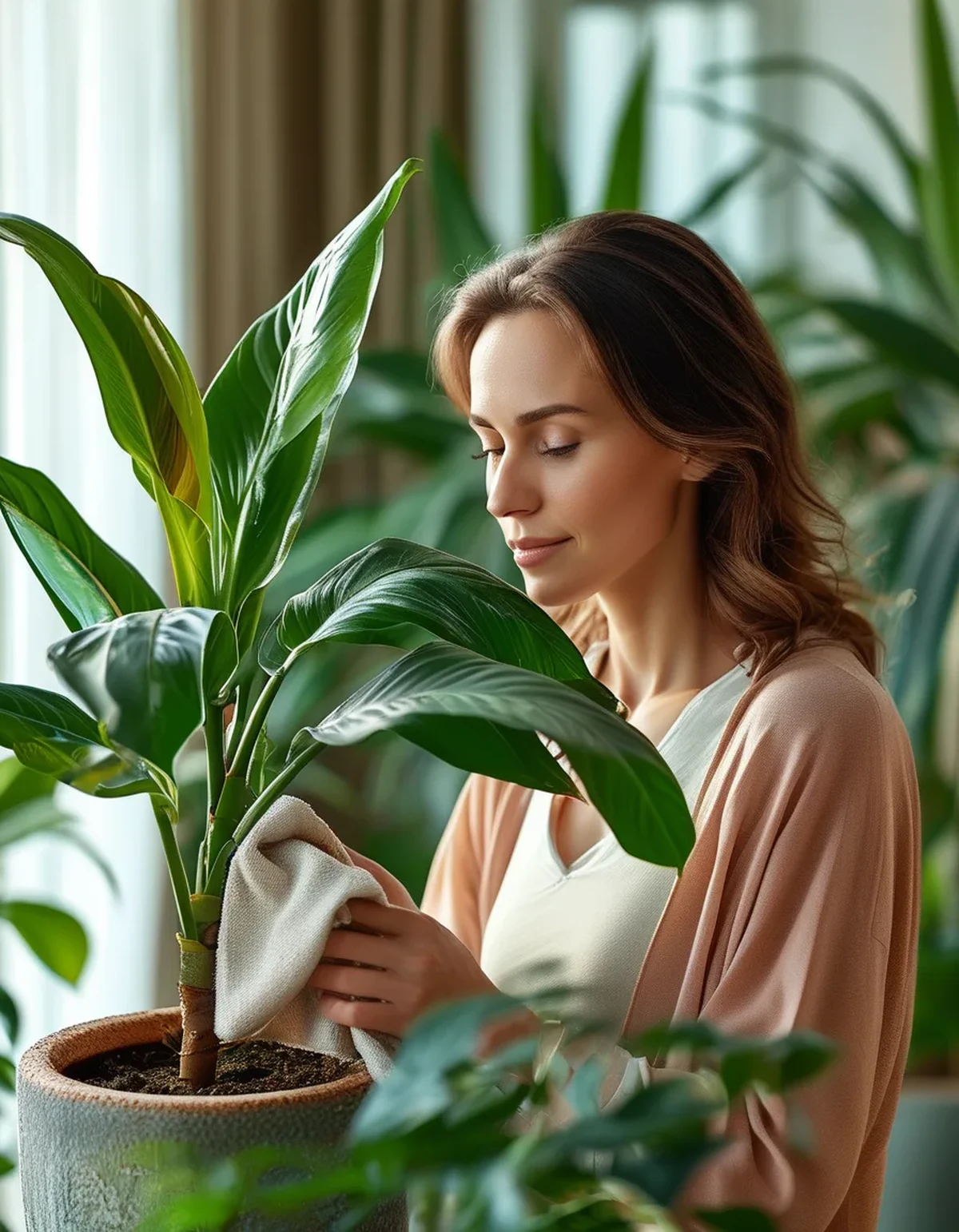
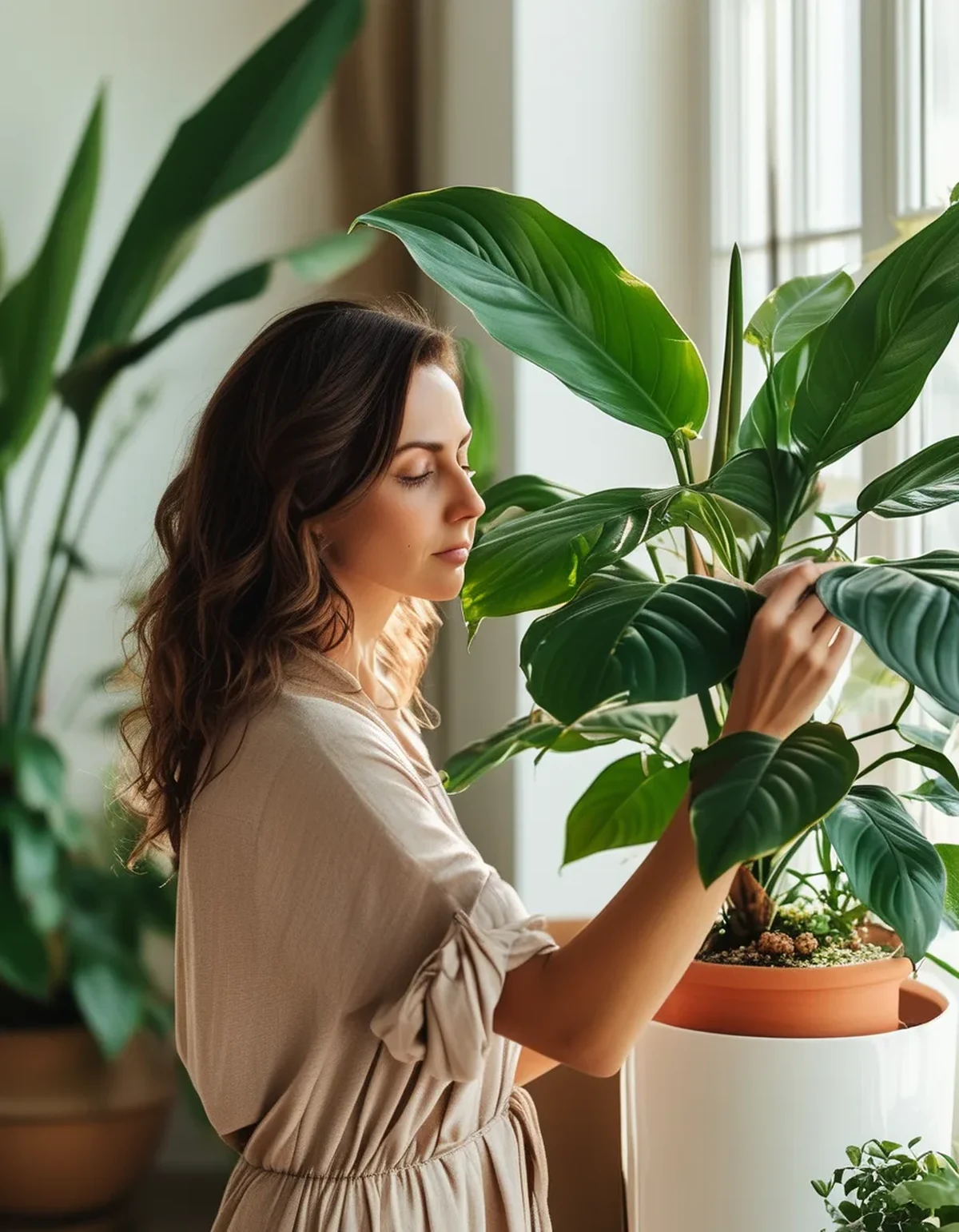
Large smooth leaves: wipe with a damp cloth. Support the underside of the leaf with one hand and wipe the top with the other. Do both sides where practical.
Small-leaved plants: shower or rinse. A lukewarm shower or a gentle rinse in the sink is faster than wiping hundreds of leaves.
Fuzzy leaves: use a soft brush. African violets and similar plants should not get water on the foliage. A soft paintbrush works.
Cacti and succulents: a dry brush. They collect dust too, and a soft brush is all that is needed.
Use plain lukewarm water. Cold water can mark leaves on some species, and there is no need for anything else.
Skip leaf shine products. They can clog stomata, which defeats the purpose entirely. If you want gloss, clean water and a cloth produce it naturally.
How often, and what else should you check?
Little and often, and use the moment to do everything else.
Every four to six weeks is a good default. More often in dusty homes, near open windows or once heating is running.
The finger test tells you. Run a finger across a leaf. If it leaves a clean line, it was overdue.
Use the clean as an inspection. Handling every leaf is when you find spider mites, scale and mealybugs, which is arguably more valuable than the cleaning itself.
Check the undersides specifically. Almost every common pest starts there, and almost nobody looks.
Rotate the pot while you are there. A quarter turn each time prevents one-sided growth toward the window.
Autumn note: this is the highest-value time of year for it. Daylight is falling fast, heating brings a surge in indoor dust, and plants are entering lower-growth months where every bit of usable light counts. A wipe-down at the start of October is worth more than one in June.
Myth vs Fact: Cleaning Houseplant Leaves
Myth: Misting cleans the leaves
Fact: Misting deposits water and leaves the dust in place, often as spots. Wiping removes it; misting redistributes it.
Myth: Leaf shine products are good for plants
Fact: They can block stomata and interfere with gas exchange. Water and a cloth is better.
Myth: Only large-leaved plants need cleaning
Fact: All of them collect dust. The method differs; the need does not.
Myth: Dust is only a cosmetic issue
Fact: It reduces usable light and can obstruct gas exchange. It is a functional problem that happens to also look bad.
Myth: A shower is bad for houseplants
Fact: A lukewarm shower is excellent for most tropical foliage plants, and it also flushes soil salts if the pot drains freely.
Myth: Moving to a brighter spot solves a light problem
Fact: It might, and a dusty plant in a bright spot is still receiving less than it should. Clean first, then evaluate the position.
FAQ: Dust and Houseplant Light, Answered
How often should I clean leaves?
Every four to six weeks as a default, more often in dusty homes or once heating is running.
Can I use soap?
A very dilute mild soap is used for pest treatment, not routine cleaning. Plain water is sufficient and safer for routine work.
Should I clean the undersides?
Where practical, yes. Stomata are concentrated on undersides in many species, and it is also where pests hide.
Does this apply to artificial light too?
Yes, and grow lights make it more important, because you are paying for that light directly.
Is a shower safe for all plants?
Good for most tropical foliage plants. Avoid it for fuzzy-leaved plants and most cacti and succulents.
Will cleaning fix a struggling plant?
It removes one limitation. If light was the constraint and dust was making it worse, you will see a difference within a few weeks. If the problem is watering or roots, cleaning will not address it.
TL;DR:
- Dust blocks and scatters light before it reaches the leaf and can partially obstruct stomata.
- Indoor light is already marginal, so the proportional loss matters more than it would outdoors.
- Wipe large leaves with a damp cloth, shower small-leaved plants, brush fuzzy ones.
- Skip leaf shine products — they clog the pores you are trying to help.
- Clean every four to six weeks, and use it to inspect leaf undersides for pests.
Before you move a struggling plant again, wipe its leaves. It costs five minutes and it may be the whole problem.
Keep Reading
This article is for general informational and styling purposes only. Fit, sizing, and product availability may vary.