Why Bottom Watering Fixes Problems That Watering From Above Never Will
Quick Answer: When potting mix dries out fully it becomes hydrophobic and pulls away from the pot walls, so water poured on top runs down the gap and out the drainage hole without wetting the root ball. Bottom watering forces water upward through capillary action, rehydrating the whole mix evenly. It also keeps the top layer dry, which breaks the fungus gnat breeding cycle.
You watered it thoroughly. Water came out the bottom within seconds.
Two days later the plant is wilting and the middle of the root ball is bone dry.
Why does water run straight through a dry pot?
Because dry potting mix actively repels water, and the pot has developed an escape route.
Peat and coir become hydrophobic when fully dry. These materials, which make up most commercial potting mixes, resist rewetting once they pass a certain dryness. Water beads and runs off rather than soaking in.
Dry mix shrinks away from the pot walls. As it dries it contracts, opening a gap between the root ball and the pot. That gap is the path of least resistance, so water pours down the side and out the bottom in seconds.
Fast drainage looks like success and is the opposite. Water appearing in the saucer immediately is the clearest sign that it bypassed the root ball entirely. Properly absorbed water takes time to come through.
The root ball can stay dry indefinitely. You can water a plant weekly for a month and have a completely dry core, which is why plants sometimes decline while receiving apparently adequate water.
The weight test reveals it instantly. Lift the pot right after watering. If it still feels light, the water went around rather than in — and this is a far more reliable check than any surface inspection.
What does bottom watering actually do differently?
It uses capillary action, which does not care about the gap at the edges.
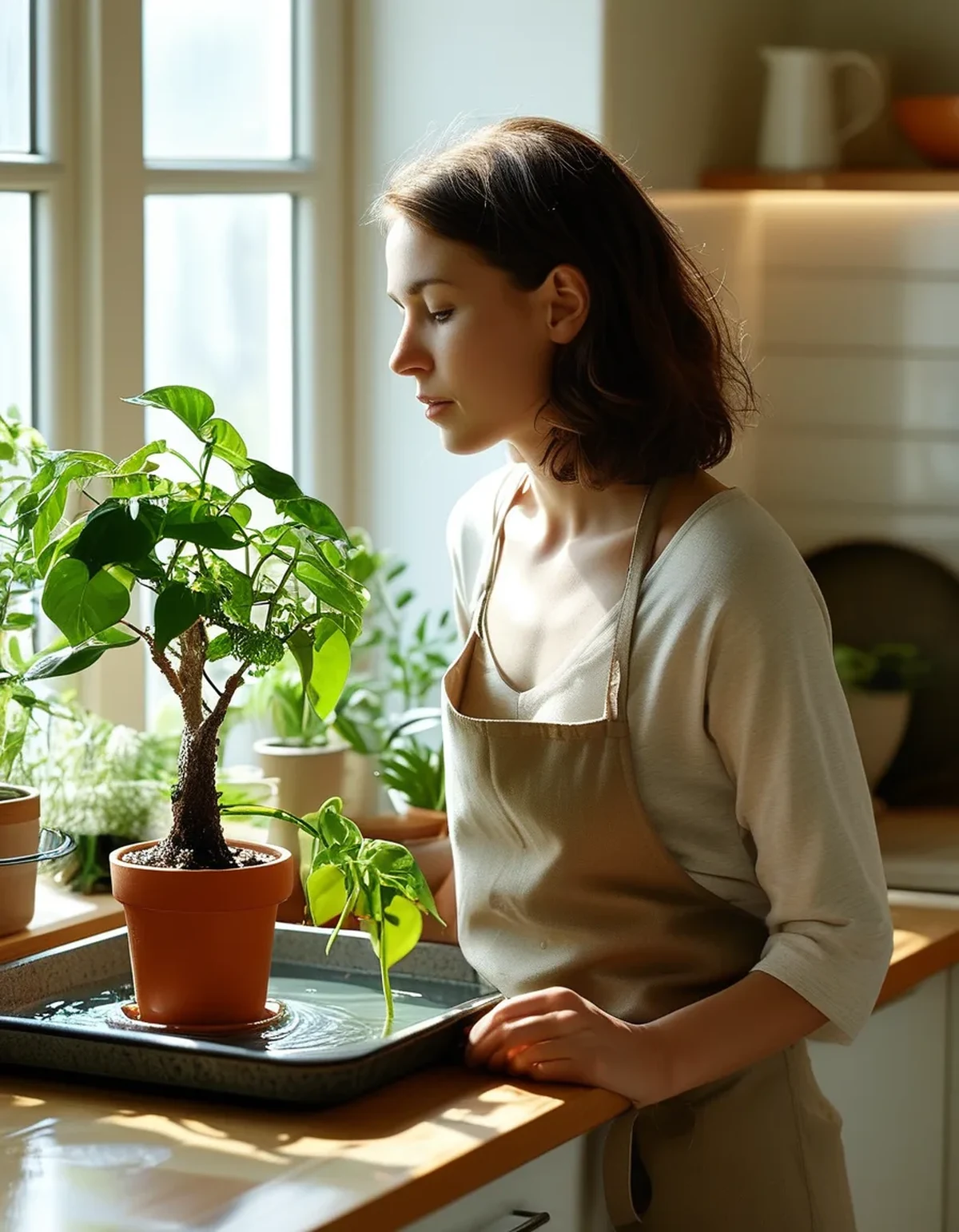
Water moves upward through the mix. Placed in a tray of water, the pot draws moisture up through the drainage hole by capillary action, wetting the mix from the bottom up.
It rehydrates hydrophobic material gradually. Slow, sustained contact is what overcomes the water repellency that a quick pour cannot. Time is doing the work rather than volume.
It wets the whole root ball evenly. Because it moves through the medium rather than around it, the core gets water rather than just the outside.
The top layer stays dry, and that is a feature. Fungus gnats lay eggs in the top inch or two of moist soil. A consistently dry surface breaks their cycle, which is why bottom watering is the standard recommendation for a gnat problem.
It is very hard to overwater this way. The mix only takes up what it can hold. Remove the pot after 20 to 30 minutes and the excess is simply not there to cause problems.
Myth vs Fact: Watering Houseplants
Myth: Water running out the bottom means the plant is thoroughly watered. Fact: It usually means the opposite when it happens fast. Immediate runoff is the classic sign of a hydrophobic, shrunken root ball. Slow seepage after a minute or two is the version that indicates actual absorption.
Myth: Bottom watering causes salt buildup, so you should not do it. Fact: It does concentrate mineral salts at the top of the soil over time, which is a real effect. The solution is to top water thoroughly every fourth or fifth watering to flush them through — not to abandon the method.
Myth: The finger test tells you when to water. Fact: It tells you about the top inch, which is the part that dries first and fastest and is least representative of the root zone. Pot weight is a substantially better indicator, and it costs nothing to learn.
Myth: Bottom watering takes too long to be practical. Fact: It is 20 to 30 minutes of unattended soaking. You put the pots in a tray and walk away. For most people it is less hands-on time than careful top watering, especially with several plants at once.
Myth: Some plants cannot be bottom watered. Fact: Almost all can. The exceptions are practical rather than botanical — very large pots are unwieldy, and plants in decorative pots without drainage holes cannot be bottom watered because there is no path for the water.
How do you actually do it?
Simple method, one timing rule, and one maintenance step.
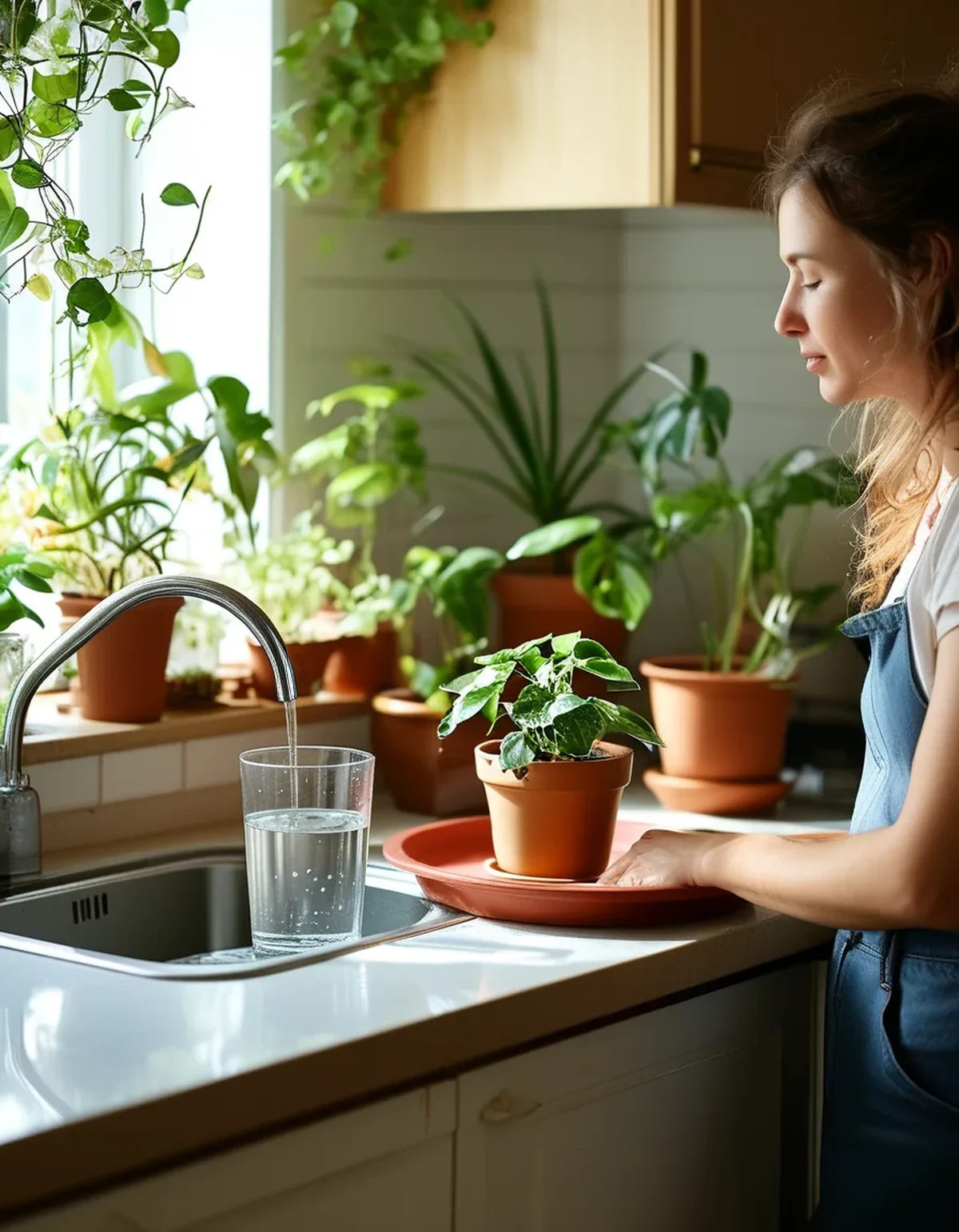
Use a tray or sink with 1 to 2 inches of water. Enough to reach above the drainage holes, not enough to submerge much of the pot.
Leave it 20 to 30 minutes. Check the surface — when the top of the soil darkens slightly, water has traveled the full height of the pot and it is done. Larger pots take longer, up to 45 minutes.
Remove it and let it drain fully. Never leave a pot sitting in water indefinitely. The mix has taken what it needs and continued contact is where root rot risk actually comes from.
Top water every fourth or fifth time to flush salts. Run water through generously from above until it drains freely. This prevents the mineral crust that otherwise builds up.
Seasonal note: as heating comes on in autumn, indoor humidity drops sharply and the top layer dries faster while the core stays wet longer in lower light. This is exactly when the finger test becomes most misleading and the weight test most useful — many autumn plant declines are overwatering diagnosed as underwatering.
FAQ: Bottom Watering, Answered
How do I know when the plant needs water at all?
Weight. Lift the pot right after watering and again a few days later, and you learn the difference quickly. It reflects the whole pot rather than the top inch, and after two weeks you will judge it accurately without thinking.
Can I bottom water plants that are already in trouble?
If the problem is a dry, hydrophobic root ball, yes — and it is often the fastest fix available. If the problem is root rot from staying too wet, adding water makes it worse. Check the difference by smell and by root firmness before deciding, since wilting looks identical in both cases.
Does it work for every pot size?
It works for anything you can lift. Very large floor plants are impractical to move, so those are better served by slow, patient top watering in stages — pour a little, wait five minutes, pour again — which achieves something similar by giving the mix time to absorb.
TL;DR:
- Dry potting mix repels water and shrinks from the pot walls, so top water runs down the gap and out
- Fast runoff means the water missed the root ball; slow seepage means it absorbed
- Bottom watering uses capillary action to wet the whole root ball evenly from below
- A dry top layer breaks the fungus gnat breeding cycle, which is why it fixes gnats too
- Soak 20 to 30 minutes, drain fully, and top water every fourth time to flush salts
The reason this fixes so many unrelated-seeming problems is that they were never unrelated. Runoff, wilting, and gnats are all downstream of water not reaching the middle of the pot.
Keep Reading
This article is for general informational and styling purposes only. Fit, sizing, and product availability may vary.