Why a Plant That Was Fine All Summer Declines in Three Weeks
Quick Answer: Late summer into early autumn brings a rapid drop in both the intensity and duration of light reaching an indoor plant — often 40 percent or more within a few weeks — while your watering routine stays the same. Less light means slower photosynthesis, slower water use, and soil that stays wet far longer. Most autumn plant decline is root suffocation caused by an unchanged watering schedule meeting a changed light environment, not by anything you did differently.
The fix is almost always to water less often, not to move the plant or feed it.
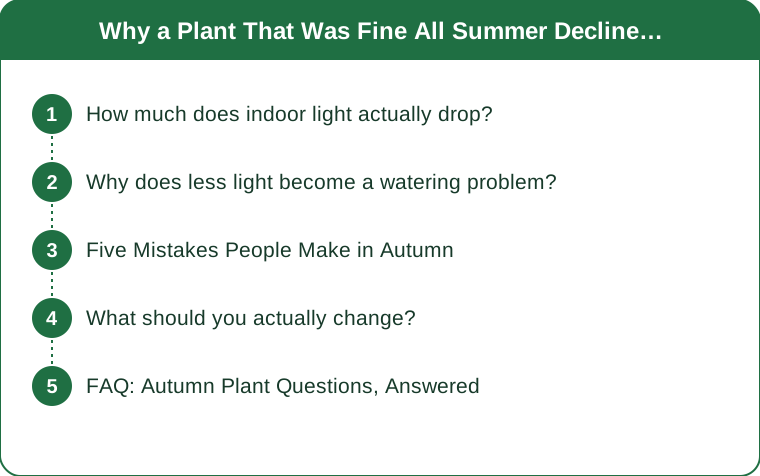
How much does indoor light actually drop?
Far more than it looks, because your eyes adapt continuously.
Two things fall at once. Day length shortens, cutting total hours of usable light. And the sun’s angle lowers, which means light passes through more atmosphere and arrives at a shallower angle to a vertical window.
The combined effect on the light reaching a plant a metre from a window can be a reduction of 40 to 60 percent between mid-August and late September, depending on latitude and window orientation.
Your perception registers almost none of this. Human vision adapts over an enormous range, so a room that measures dramatically darker still looks bright. This is the single reason autumn plant decline surprises people.
Window direction changes the size of the effect. A south-facing window loses intensity but gains depth as the lower sun angle pushes light further into the room, which can actually improve conditions for a plant sitting well back. An east or north window loses badly with no compensation.
A phone light meter app is imprecise but adequate for the comparison that matters: measure the same spot in August and again in late September. Seeing the number halve is what makes the adjustment feel justified.
Why does less light become a watering problem?
Because a plant’s water use is driven almost entirely by photosynthesis and transpiration, both of which scale with light.
In strong light, a plant is actively moving water from soil through roots and out through leaves. That is what dries the pot. Reduce the light and you reduce the pump. The same pot in the same room with the same plant now takes considerably longer to dry.
If your watering is on a schedule — every Sunday, say — you are now adding water to soil that has not finished using the last lot. Within two or three cycles the root zone is continuously saturated.
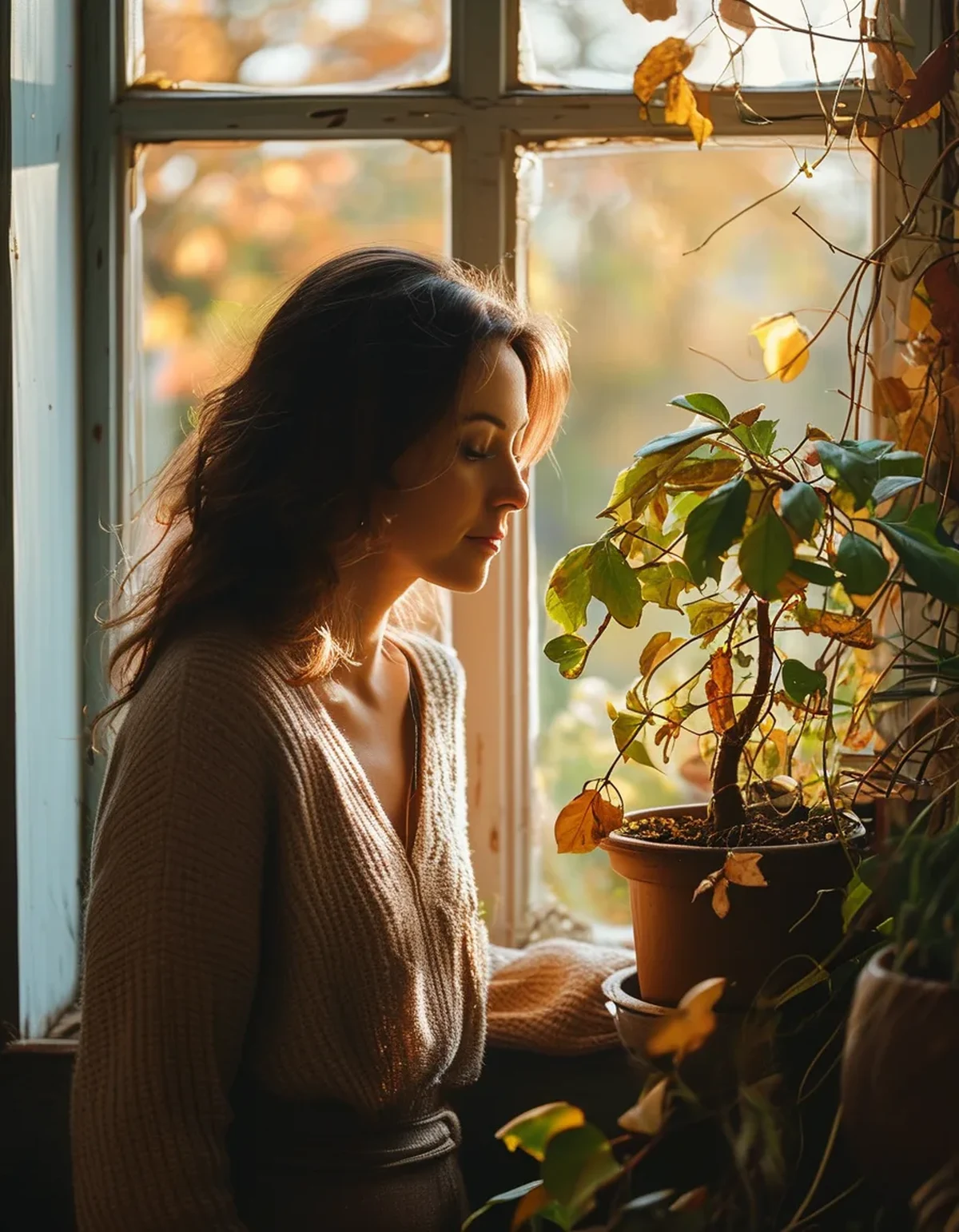
Saturated soil has no air in it. Roots need oxygen, and roots sitting in oxygen-free soil begin to die within days. Dying roots cannot take up water, so the plant wilts — which looks exactly like it needs water, which prompts more watering, which accelerates the problem.
This is the most common way a healthy houseplant is killed, and it happens overwhelmingly in autumn. The symptom picture is specific: yellowing lower leaves, a wilting plant in wet soil, sometimes a sour smell from the pot, and often fungus gnats appearing at the same time.
Cool temperatures compound it. As indoor temperatures drop with the season, evaporation slows further and the soil stays wet longer still.
Five Mistakes People Make in Autumn
Watering on a schedule. The single biggest one. Water by checking the soil, not by the calendar. Push a finger two to three centimetres in, or lift the pot and judge by weight — weight is the more reliable method once you learn each plant.
Fertilizing into the slowdown. Most houseplants reduce growth substantially as light drops. Feeding a plant that is not growing puts unused salts into the soil, which can burn roots. Reduce or stop feeding from early autumn until spring.
Repotting in autumn. Repotting is a stress that a plant recovers from using energy it gets from light. Doing it as light declines means a long, difficult recovery. Spring is the right window for all but emergencies.
Moving plants closer to the radiator. Understandable and counterproductive. Dry radiator heat lowers humidity dramatically while doing nothing about light, and most common houseplants suffer from low humidity more than from cool temperatures.
Assuming leaf drop is a problem. Some leaf loss when light drops is normal — the plant is shedding leaves it can no longer support. A few lower leaves yellowing and dropping over a few weeks is adjustment. Rapid loss, mushy stems, or new growth failing is not.
What should you actually change?
Four adjustments, made in early autumn rather than after symptoms appear.
Extend the interval between waterings, substantially. For many plants this means going from weekly to every ten to fourteen days. Check before every watering rather than assuming, because the correct interval will keep lengthening through the season.
Move plants closer to windows. A plant that thrived a metre back in July may need to be at the glass in October. This is the one move worth making — and it is the reverse of the summer advice, when the same spot risked scorching.
Clean the leaves and the windows. Dust on leaves measurably reduces light capture, and a dirty window reduces transmission further. Both are trivial to fix and both matter more when light is scarce.
Consider a grow light for genuinely dark spots. A modest LED on a timer for eight to ten hours a day transforms what is possible in a north-facing room. This has moved from a specialist thing to a cheap and effective one.
And resist the urge to intervene more broadly. Autumn is the season to do less, not more. Less water, less feed, no repotting, no propagation. Plants are entering a lower-activity period, and most autumn losses come from care given rather than care withheld.
FAQ: Autumn Plant Questions, Answered
How do I tell overwatering from underwatering when both cause wilting?
Check the soil. Wilting in wet soil is root damage from overwatering; wilting in dry soil is underwatering. The leaf appearance is similar, so the soil is the only reliable signal.
Should I mist to raise humidity?
Misting raises humidity for a few minutes and then stops. A pebble tray, grouping plants together, or a small humidifier all work considerably better if humidity is genuinely the issue.
My plant dropped half its leaves — will it recover?
Usually, if the stems are firm and the roots are healthy. Move it to the brightest available spot, cut watering back, stop feeding, and wait. Recovery often does not begin visibly until light increases again in late winter.
TL;DR:
- Indoor light can drop 40 to 60 percent between mid-August and late September, and your eyes will not notice.
- Less light means slower water use, so an unchanged watering schedule drowns the roots.
- Wilting in wet soil is root damage, not thirst — the most common autumn misdiagnosis.
- Water by checking, move plants toward windows, clean the leaves, stop feeding, and do not repot.
Lift each pot today and learn what it weighs when it needs water. That one habit prevents nearly every autumn houseplant loss.
Keep Reading
This article is for general informational and styling purposes only. Fit, sizing, and product availability may vary.