Free Plants Forever: The Water-Glass Propagation Starter Guide
Quick Answer: Cut a stem just below a node — the small bump where a leaf meets the stem — put the node in water with all leaves above the surface, and set it on a bright indirect windowsill. Roots appear in 1–4 weeks. At 5–8 cm of root, pot it in regular potting mix. Pothos, philodendron, spider plants, and tradescantia are the easiest starters.
Here’s the plant world’s best-kept open secret: most of your houseplants will make you more houseplants, for free, using a glass of water and some patience.
Snip. Glass. Windowsill. Wait.
One pothos becomes a dynasty. And watching white roots inch out through clear glass turns out to be unreasonably compelling television — there’s a reason people keep propagation jars where they can see them.
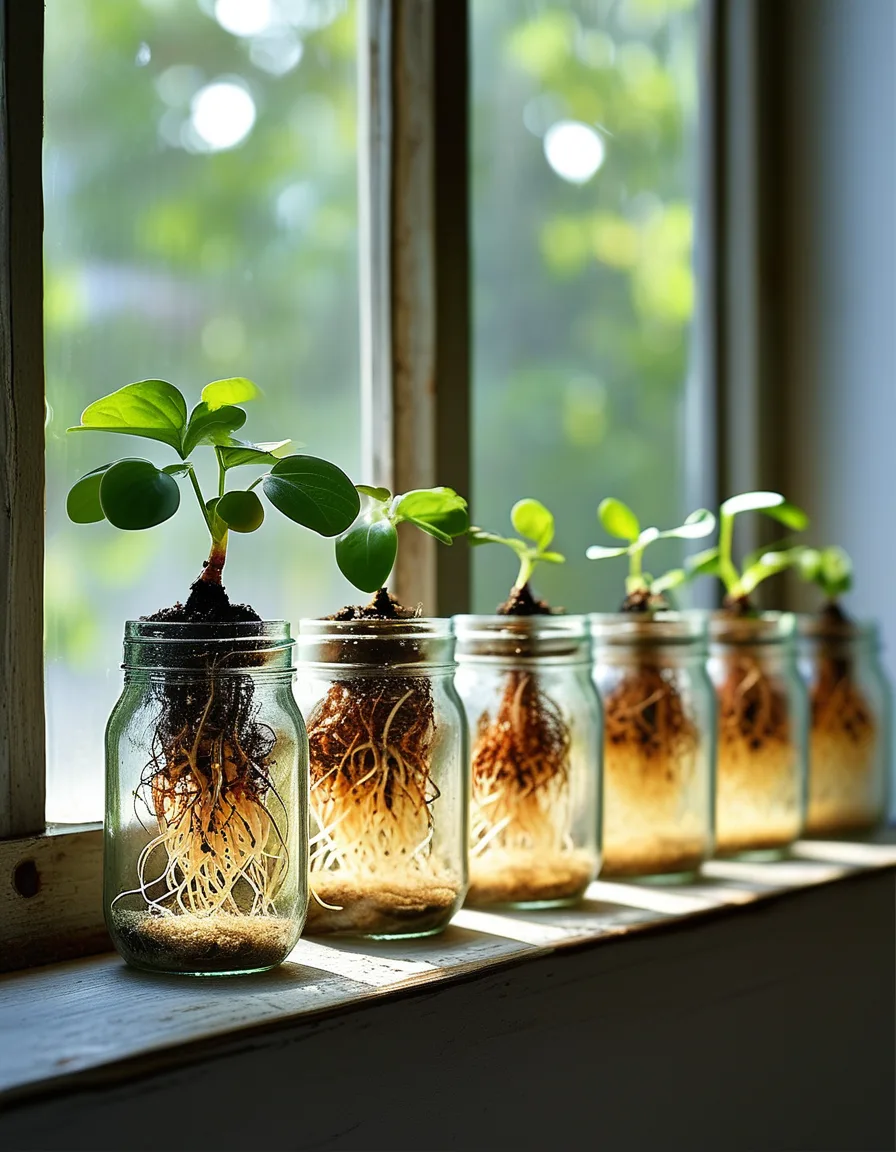
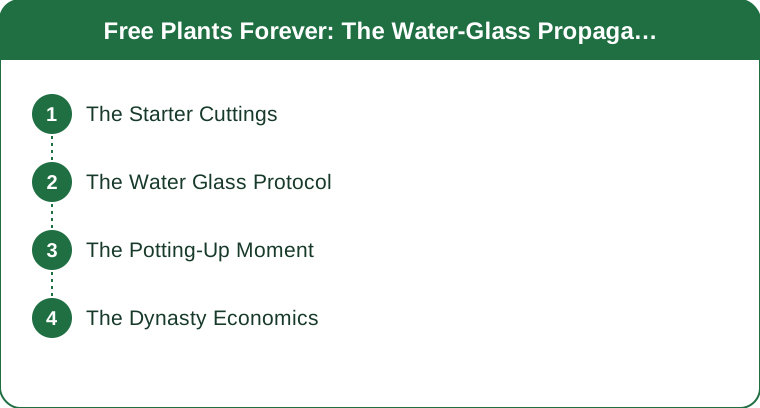
Which plants propagate easiest in water?
Start with these four and you’ll succeed on your first attempt.
- Pothos. The gateway plant. Roots in 1–3 weeks, tolerates neglect, nearly impossible to fail. If you’ve never propagated anything, start here.
- Spider plant babies. These are pre-made — the plantlets dangling on runners already have root nubs. Detach one and put it in water. It’s almost cheating.
- Philodendron (heartleaf and most trailing types). Same behavior as pothos, roots in 2–4 weeks.
- Tradescantia. Roots so enthusiastically it feels like showing off. Often visible root growth within 5–7 days.
Also reliable: monstera (slower, 4–8 weeks), coleus, mint and basil, begonia, and Chinese money plant offsets.
What doesn’t work in water: succulents and cacti rot rather than root — those propagate dry, on soil. Snake plants technically work but take months and often lose their variegation. Fiddle leaf figs are possible but temperamental.
How do I actually take a cutting?
The node is everything. Get this right and the rest is waiting.
A node is the small bump or ring on the stem where a leaf or aerial root emerges. It’s the only place roots will launch from — a stem cut between nodes will sit in water indefinitely and eventually turn to mush.
The method:
- Find a healthy stem with at least 2–4 leaves.
- Cut about 0.5–1 cm below a node, using clean scissors or shears. Wipe the blades with alcohol first if you’ve been trimming anything sickly.
- Strip the leaves off the bottom section so nothing will sit underwater.
- Aim for 10–15 cm of cutting with 1–2 nodes submerged and at least 2 leaves above water.
Cuttings with 2–3 leaves root faster than a long vine with eight — the plant has less foliage to support and can put its energy into roots.
The water glass protocol
Simple rules, and the failures almost always come from breaking one of them.
- Node underwater, every leaf above it. Submerged leaves rot, the water goes cloudy and foul, and the rot spreads to the stem. This is failure cause number one by a wide margin.
- Bright indirect light. A windowsill that gets plenty of light but not hours of direct midday sun. Direct sun cooks the water and encourages algae.
- Change the water weekly. Fresh water carries oxygen, which roots need. Stagnant water is where things go wrong. Tap water is fine for most plants; if yours is heavily chlorinated, let it sit out overnight.
- Room temperature, roughly 18–24°C. Cold windowsills in winter slow everything down dramatically.
- Clear glass, if you want to enjoy it. Roots don’t care, but you will.
Expect roots in 1–4 weeks depending on species and season. Spring and summer are noticeably faster than winter — sometimes twice as fast.

When do I move it to soil?
At 5–8 cm of root length. Longer isn’t better.
This is the counterintuitive part: water roots and soil roots are structurally different, and the longer a cutting lives in water, the more committed it gets to being a water plant. A cutting with 20 cm of water roots transitions much worse than one with 5 cm.
The potting-up method:
- Small pot — about 10 cm. A big pot holds too much moisture around a small root system.
- Regular potting mix, pre-moistened so it’s damp but not soggy.
- Keep it slightly moister than usual for the first two weeks while the water roots adapt to soil.
- Expect a droop. Almost every cutting sulks for a few days after potting. It looks alarming and it’s completely normal — the recovery arrives within a week or two.
Some people skip the transition entirely by rooting straight into damp soil or sphagnum moss. It works well and produces sturdier roots. You just don’t get to watch, which for many of us is the whole point.
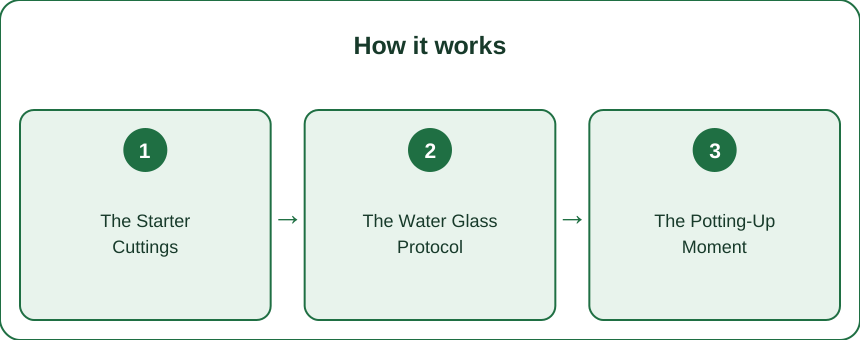
What Nobody Tells You
The math compounds fast. One pothos gives you four cuttings. Four rooted cuttings become four plants, each of which can give four more in a few months. The plant you bought in spring for $12 is quietly eight plants by winter. Your shelf was never a collection — it was a colony with a growth plan.
A rooted cutting in a nice jar is an excellent gift. It costs nothing, it looks thoughtful, and plant people trade cuttings the way other hobbies trade equipment. Plant swap culture runs almost entirely on this.
Cloudy water means start over on the water, not the cutting. Rinse the stem, wash the glass, refill. A cutting usually survives one bad water episode.
Rooting hormone is optional for water propagation. It helps a little with stubborn woody cuttings and does essentially nothing for pothos, which doesn’t need the encouragement.
FAQ
How long does it take for cuttings to root in water?
Typically 1–4 weeks, depending on species and season. Tradescantia and pothos can show roots within 7–10 days in summer, while monstera often takes 4–8 weeks. Everything roots more slowly in winter, sometimes taking twice as long.
Why is my cutting rotting instead of rooting?
Almost always because a leaf is submerged, the water hasn’t been changed, or the cut wasn’t made at a node. Rot appears as a mushy, browning stem end and cloudy, smelly water. Trim above the rotted section, back to healthy tissue and just below a node, then restart in clean water.
Can I leave cuttings in water permanently?
You can, and many people do — pothos in particular will live in a jar for years if you change the water regularly and add a very dilute liquid fertilizer occasionally. It just won’t grow as vigorously as it would in soil, and the longer it stays, the harder the eventual transition.
TL;DR:
- Cut just below a node; that bump is where roots come from.
- Node underwater, all leaves above — submerged leaves are the top cause of failure.
- Bright indirect light, water changed weekly, room temperature.
- Pot up at 5–8 cm of root, in a small pot, kept slightly moist for two weeks.
- Expect a droop after potting; it recovers.
- Easiest starters: pothos, spider plant babies, philodendron, tradescantia. Skip water propagation for succulents.
Keep Reading
This article is for general informational and styling purposes only. Fit, sizing, and product availability may vary.