Why Leaf Drop and Yellow Leaves on Houseplants Usually Mean Different Things
Quick Answer: Yellowing leaves most often point to a watering imbalance (usually overwatering), while sudden leaf drop without yellowing more often signals environmental shock — a move, temperature change, or drafts — meaning the two symptoms usually call for different fixes rather than the same watering adjustment.
Treating leaf drop like a watering problem when it’s actually shock-related is a common reason houseplant troubleshooting doesn’t work the first time.

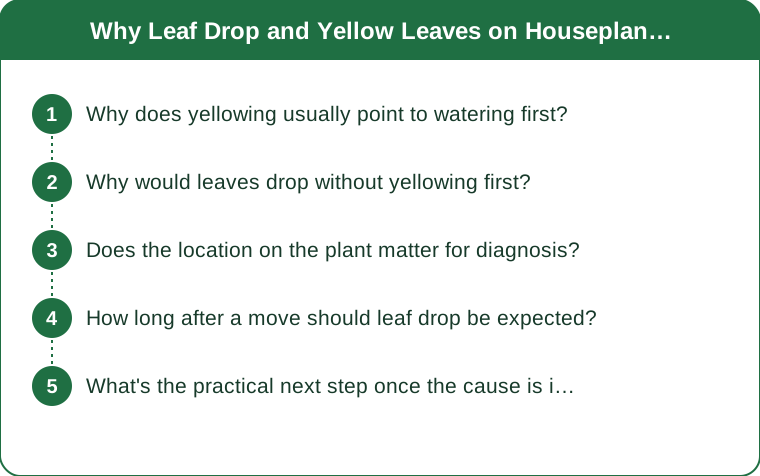
Why does yellowing usually point to watering first?
Chlorophyll breakdown from root stress, most commonly caused by roots sitting in overly wet soil, shows up as a gradual yellowing before the leaf eventually drops, making the color change itself the earlier and more diagnostic signal compared to leaf drop alone.
Why would leaves drop without yellowing first?
A plant experiencing sudden environmental stress — a cold draft, a big light change after a move, or transport shock from a recent purchase — often sheds leaves as a survival response before any gradual color change has time to develop, which is why drop without yellowing points more toward shock than a slow nutrient or water issue.

Does the location on the plant matter for diagnosis?
Yes — yellowing that starts with older, lower leaves while new growth stays healthy often points to a nutrient or watering issue working through the plant gradually, while widespread drop across all levels of the plant at once more often reflects a sudden shared stressor like temperature or relocation.
How long after a move should leaf drop be expected?
Some leaf drop within the first one to three weeks after a significant move or environment change is common and often resolves on its own as the plant adjusts, whereas continued dropping well beyond that window suggests an ongoing issue rather than initial adjustment stress.
What’s the practical next step once the cause is identified?
For yellowing, checking soil moisture and adjusting the watering schedule is the priority; for shock-related drop, minimizing further changes (no repotting, no fertilizing, no relocating) and simply giving the plant time to stabilize tends to be the more effective response than trying to actively intervene further.
TL;DR:
- Yellowing most often reflects a watering imbalance, typically overwatering
- Sudden drop without yellowing usually signals shock from environmental change
- Where yellowing starts on the plant helps narrow the cause further
- Shock-related drop generally needs stability and patience, not more intervention
Matching the fix to the actual symptom pattern works better than defaulting to a watering adjustment for every issue.
Keep Reading
This article is for general informational and styling purposes only. Fit, sizing, and product availability may vary.